There was a time when launching a consumer brand online looked almost too easy.
Create a product. Build an Instagram page. Run advertisements. Get influencers involved. Raise funding. Grow quickly.
That formula helped create some of India’s most recognisable direct-to-consumer brands.
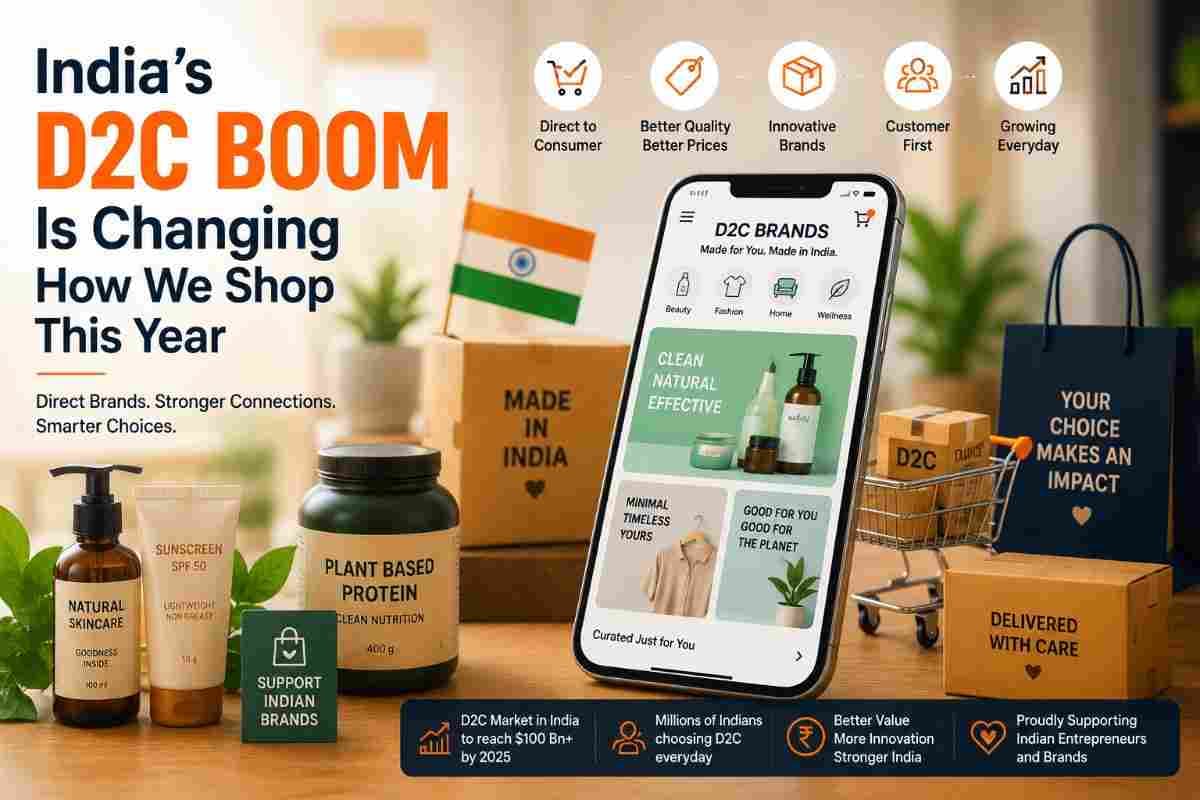
But the D2C market is entering a different phase now.
Recent reporting says Indian D2C companies raised nearly $6 billion across around 2,000 equity funding rounds between January 2021 and August 2026. The sector is still attracting money, but investors are becoming more selective.
The conversation is shifting from “How fast can this brand grow?” to “Can this brand make money?”
The easy-growth era is fading
Customer acquisition is not cheap.
A brand can spend heavily on advertising and show impressive sales growth while losing money on every first order.
That model can work temporarily when investors are willing to fund expansion. It becomes much harder when capital becomes expensive and investors demand clearer economics.
That is why retention is becoming so important.
A customer who buys once is useful.
A customer who comes back three or four times can completely change the economics of a D2C business.
Why repeat customers matter
Imagine a skincare brand spending ₹500 to acquire a customer.
If that customer buys a ₹700 product once, the brand may struggle after accounting for manufacturing, shipping, payment costs and returns.
But if the same customer returns every few months, the original acquisition cost is spread across several purchases.
That is why brands are paying more attention to communities, product quality, loyalty programmes and customer experience.
The best D2C businesses are not simply trying to sell more.
They are trying to build habits.
Marketplaces are not disappearing
There is sometimes an assumption that D2C means avoiding marketplaces completely.
In reality, many brands use a combination of channels.
Their own website provides customer data and control over the experience. Marketplaces provide reach and discovery. Physical stores can create trust and allow customers to experience products directly.
The winning strategy may therefore be less about choosing one channel and more about using each channel for the job it does best.
Quick commerce is changing expectations
Indian consumers are also becoming accustomed to speed.
Quick-commerce platforms have trained customers to expect convenient discovery and fast delivery for an increasing range of products.
That creates an opportunity for consumer brands, but it also creates pressure.
A brand may have a great product, but if the customer cannot find it where they normally shop, another product can win.
Distribution is therefore becoming as important as advertising.
Profitability is the new growth story
The D2C sector is not becoming less competitive. It is becoming more disciplined.
Investors want to see sensible customer acquisition costs, healthy gross margins, repeat purchases and efficient operations.
This does not mean brands should stop growing.
It means growth needs to make economic sense.
A smaller brand with loyal customers and strong margins can be more attractive than a huge brand that depends on constant advertising and fresh funding.
What should founders focus on?
First, understand the numbers behind every order.
How much does it cost to acquire a customer?
How much does the average customer spend?
How often do they return?
How much money is left after product, shipping, returns and marketing costs?
Second, build a product customers actually want.
Marketing can create the first sale. Product quality is what creates the second.
Third, control inventory carefully.
Too much inventory locks up cash. Too little can lead to stockouts and lost customers.
The D2C opportunity is still huge
India's consumer market is large, digital and increasingly comfortable buying products online.
That creates room for new brands.
But the next generation of successful D2C companies may look different from the first generation.
They may grow more slowly.
They may raise less money.
They may focus on fewer products.
And they may care much more about cash flow.
That is not a bad thing.
It could make the industry healthier.
The bottom line
India’s D2C story is not ending. It is growing up.
The brands that survive the next phase are likely to be the ones that understand their customers deeply, control costs and build products people genuinely want to buy again.
The future of D2C may not belong to the brand with the loudest marketing.
It may belong to the brand whose customers quietly keep coming back.
Disclaimer: This article is for informational purposes only and does not constitute investment or business advice.
The D2C customer is becoming harder to impress
Online shopping has made comparison extremely easy.
A customer can see several similar products, check reviews, compare prices and switch brands within minutes. That means a D2C company cannot depend on a strong advertisement alone.
Trust matters.
Reviews matter.
Delivery matters.
Packaging matters.
And, most importantly, the product has to work.
This is why repeat purchase is such a useful measure. It tells a brand whether customers came back after the excitement of the first purchase disappeared.
Private labels and established companies are competing too
D2C brands are not operating in an empty market.
Traditional consumer companies have strong distribution, manufacturing relationships and brand recognition. Marketplaces have huge audiences. New startups continue to enter niche categories.
The result is a crowded battlefield.
A new brand therefore needs a reason to exist beyond “we are available online.”
It might have a better formulation, a sharper niche, stronger community, better pricing or a product designed for an underserved customer group.
Offline expansion can be useful—but expensive
Many digital-first brands eventually move into physical stores, kiosks or retail partnerships.
The advantage is obvious: customers can see and experience the product.
But physical expansion brings rent, staff, inventory and operational complexity.
A brand should therefore know why it is opening a store.
If the store improves trust, customer acquisition or repeat sales, it can make sense. If it is simply a vanity project, it can quickly become a cash drain.
The importance of contribution margin
Revenue can look impressive from a distance.
A founder needs to know what remains after the variable costs associated with making and delivering a sale.
That is where contribution margin becomes useful.
If a company sells a product for ₹1,000 but spends heavily on discounts, shipping, returns, payment charges and advertising, the actual economics may be much weaker than the headline revenue suggests.
A mature D2C business needs visibility into these numbers by product, channel and customer group.
What the next generation of D2C brands may look like
The strongest brands may be less dependent on one advertising platform and more focused on direct relationships.
Email, communities, loyalty programmes, retail presence and useful content can all help reduce dependence on constantly buying traffic.
That can make the business more resilient when advertising costs rise.
The D2C model is therefore not disappearing.
It is becoming more sophisticated.
The next big consumer brands may be built by founders who understand both branding and boring operational details such as inventory turns, margins and cash flow.
A practical way to think about D2C brands India 2026
The easiest mistake when reading business news is to look for a single number that explains everything.
Markets and businesses rarely work that way.
A headline can tell you that activity is rising, but it does not tell you whether every company in the sector will benefit. A funding announcement can show that investors are interested, but it does not prove that the business will become profitable. A new technology can create a major opportunity, but implementation can still fail.
The useful habit is to connect the headline to the underlying business model.
Who is paying?
Why are they paying?
What does it cost to serve them?
What could make the economics better or worse?
What changes if the market becomes more competitive?
Those questions are useful whether you are an investor, entrepreneur or simply someone trying to understand India's economy.
The other important habit is to separate a trend from a guarantee.
A trend tells us where activity is moving. It does not tell us exactly where the next winner will come from.
That distinction is particularly important in fast-moving areas such as technology, IPOs, startups and financial services. New companies can grow quickly, but competition can also appear quickly. Regulations can change. Consumer preferences can shift. Capital can become more expensive.
For readers, this means the most valuable business stories are not necessarily the ones with the most dramatic headlines.
They are the stories that explain what changed, why it changed and what could happen next.
That is the lens through which this trend should be viewed.
What readers should watch next
Over the coming months, pay attention to the practical signals behind the trend.
Look for companies reporting real revenue growth rather than only announcing plans. Watch whether customers continue using a product after the initial launch. Look at whether businesses can improve margins as they scale. Notice whether investment is creating new capacity, new jobs or new products.
Also watch what happens when the market becomes less supportive.
A strong business should have a strategy for difficult periods, not only good ones.
That is often where the difference between a genuine long-term trend and a short-lived boom becomes visible.
For India, the broader opportunity remains significant. A large domestic market, a growing digital economy, improving infrastructure and an increasingly connected business ecosystem create room for new companies and new business models.
But opportunity alone is not enough.
Execution will decide who benefits.
The real test is what happens after the first order
D2C brands have become very good at getting attention. The next challenge is turning that attention into a durable customer relationship.
A customer may discover a brand through a short video, an influencer or a discount. But the second purchase usually comes from a different reason: the product delivered what it promised.
That is why product development, customer support and after-sales experience are becoming just as important as marketing.
The brands that understand this can build something much more valuable than traffic.
They can build trust.
And in a crowded consumer market, trust can become one of the hardest advantages for a competitor to copy.
Disclaimer: This article is for informational purposes only and is not investment, financial or business advice.