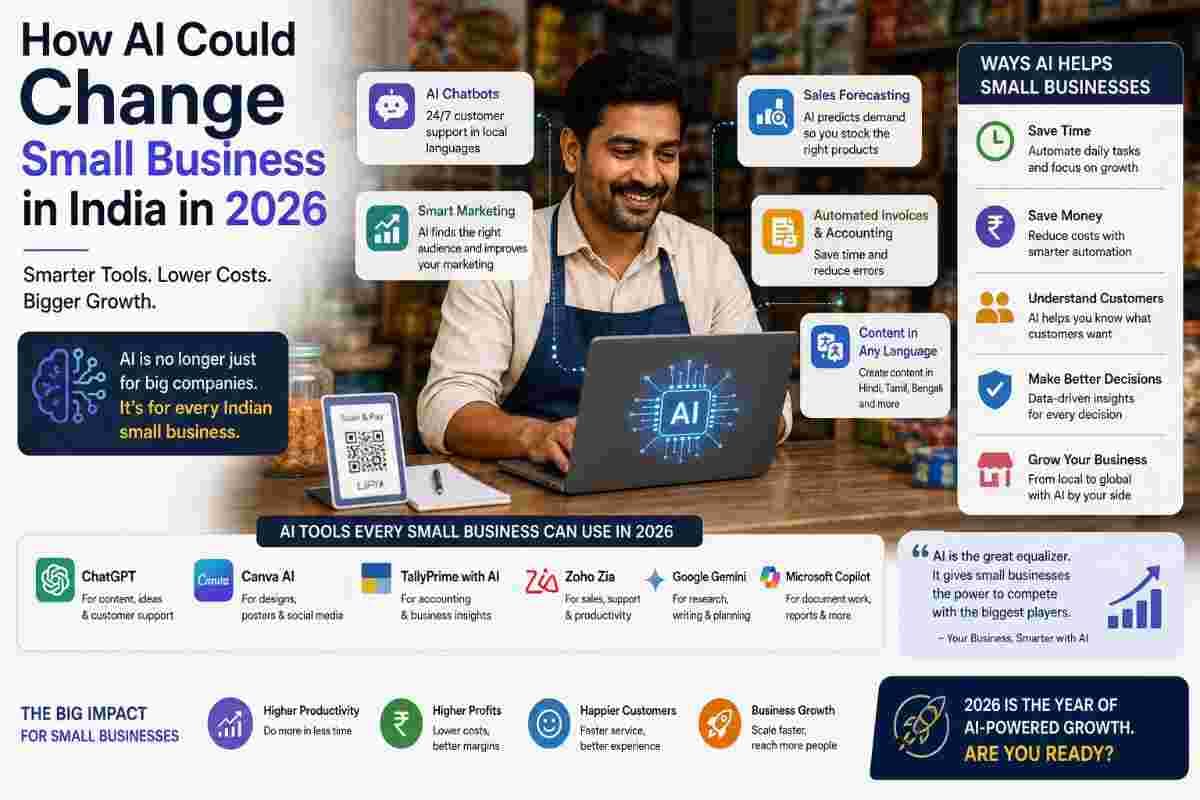
For a small business owner, AI does not need to mean building a futuristic robot.
It can mean something much simpler.
Writing a product description in seconds.
Replying to routine customer questions.
Turning sales data into a useful report.
Creating a first draft of a marketing campaign.
The important change in 2026 is that these tools are becoming accessible to businesses that do not have large technology teams.
Start with boring problems
The best AI use cases are often not glamorous.
Look at the tasks your team repeats every day.
Do employees answer the same five customer questions again and again?
Do they copy information from one spreadsheet into another?
Does someone spend hours preparing weekly reports?
Does a salesperson manually write similar follow-up emails?
These are the areas where AI can create an immediate productivity gain.
Customer service is an easy starting point
Small businesses often cannot afford a large support team.
An AI assistant can handle basic questions about products, prices, availability, delivery or policies.
But there should be a clear handoff to a human.
Customers should not have to argue with a bot when their problem is unusual.
The goal is to reduce repetitive work, not remove the human relationship.
Marketing can become faster
AI can help a small team generate ideas, write first drafts, repurpose content and analyse customer feedback.
That does not mean publishing everything AI creates.
A human still needs to check facts, tone and brand voice.
The best approach is to treat AI as a fast junior assistant rather than an unquestionable expert.
Sales teams can use AI too
A salesperson can use AI to organise leads, summarise previous conversations, prepare meeting notes and draft follow-ups.
That can save time without changing the core sales process.
The salesperson still builds the relationship.
AI simply reduces the administrative work around it.
Operations may have the biggest opportunity
Inventory, invoices, schedules and reports often contain structured data.
AI tools can help identify unusual patterns, summarise performance or create alerts.
For a small business, even a few hours saved each week can matter.
But data quality becomes important.
If the information going into the system is wrong, the AI output can also be wrong.
What should owners avoid?
Do not buy ten AI tools at once.
Choose one problem.
Measure how much time or money it currently costs.
Introduce an AI workflow.
Measure the result.
If it works, expand.
Also avoid putting sensitive customer or business information into a tool without understanding its privacy and data-handling policies.
The human advantage still matters
AI can generate content quickly.
It cannot automatically understand every customer, local market or business relationship.
Small businesses often have an advantage here.
They know their customers personally.
They understand local demand.
They can make decisions quickly.
AI should strengthen that advantage, not replace it.
The bottom line
AI can make small businesses faster without making them more complicated.
The biggest opportunity is not to automate everything.
It is to remove the repetitive work that stops owners and employees from focusing on customers and growth.
Start small.
Choose a real problem.
Measure the result.
Then build from there.
That is a much more practical AI strategy than chasing every new tool that appears online.
AI does not need to be complicated to be useful
A small business does not need a dedicated AI department.
It may only need one workflow that saves two hours a day.
For example, a local retailer can use AI to turn product information into social-media drafts. A service company can use it to organise enquiries. A small manufacturer can use data tools to create simple production summaries.
The technology is useful when it removes friction.
Start with customer communication
Many small businesses answer similar questions repeatedly.
An AI-assisted knowledge base can help prepare responses about opening hours, delivery areas, product specifications, return policies or appointment availability.
The owner still controls the final communication.
This is especially useful outside normal working hours, when a customer may otherwise receive no response.
Use AI to make existing content work harder
A small business may already have useful material but not enough time to reuse it.
One customer case study can become a website article, a short social post, an email idea and a sales presentation.
AI can help with that transformation.
The business still needs to add real examples, local context and its own voice.
That human layer is what prevents the content from becoming generic.
AI can help owners understand their numbers
Spreadsheets often contain useful information that owners do not have time to analyse.
AI-assisted tools can help summarise sales by product, identify unusual changes or turn raw figures into questions worth investigating.
The important word is assist.
Financial decisions should still be checked against the original records.
Privacy should not be an afterthought
Small businesses often handle customer phone numbers, addresses, invoices and payment information.
Before putting such information into an AI service, owners should understand the tool's data policies and avoid sharing information unnecessarily.
Good AI adoption includes good data hygiene.
Training is more important than buying tools
A business can buy a dozen subscriptions and still fail to benefit from AI.
Employees need to know what the tools are for, what information they can use and when a human should take over.
A simple internal rulebook can be more valuable than another software purchase.
Measure the benefit
The easiest way to know whether AI is helping is to measure before and after.
How long did the task take before?
How long does it take now?
Did errors increase or decrease?
Did customers receive faster replies?
Did salespeople spend more time selling?
These questions turn AI from a trend into a business decision.
The bottom line
For small businesses, AI is most useful when it quietly removes repetitive work.
There is no need to transform the whole company in one weekend.
Pick one painful process.
Automate part of it.
Check the result.
Then decide what comes next.
That practical approach can deliver more value than chasing every new AI announcement.
A practical way to think about AI for small business India
The easiest mistake when reading business news is to look for a single number that explains everything.
Markets and businesses rarely work that way.
A headline can tell you that activity is rising, but it does not tell you whether every company in the sector will benefit. A funding announcement can show that investors are interested, but it does not prove that the business will become profitable. A new technology can create a major opportunity, but implementation can still fail.
The useful habit is to connect the headline to the underlying business model.
Who is paying?
Why are they paying?
What does it cost to serve them?
What could make the economics better or worse?
What changes if the market becomes more competitive?
Those questions are useful whether you are an investor, entrepreneur or simply someone trying to understand India's economy.
The other important habit is to separate a trend from a guarantee.
A trend tells us where activity is moving. It does not tell us exactly where the next winner will come from.
That distinction is particularly important in fast-moving areas such as technology, IPOs, startups and financial services. New companies can grow quickly, but competition can also appear quickly. Regulations can change. Consumer preferences can shift. Capital can become more expensive.
For readers, this means the most valuable business stories are not necessarily the ones with the most dramatic headlines.
They are the stories that explain what changed, why it changed and what could happen next.
That is the lens through which this trend should be viewed.
What readers should watch next
Over the coming months, pay attention to the practical signals behind the trend.
Look for companies reporting real revenue growth rather than only announcing plans. Watch whether customers continue using a product after the initial launch. Look at whether businesses can improve margins as they scale. Notice whether investment is creating new capacity, new jobs or new products.
Also watch what happens when the market becomes less supportive.
A strong business should have a strategy for difficult periods, not only good ones.
That is often where the difference between a genuine long-term trend and a short-lived boom becomes visible.
For India, the broader opportunity remains significant. A large domestic market, a growing digital economy, improving infrastructure and an increasingly connected business ecosystem create room for new companies and new business models.
But opportunity alone is not enough.
Execution will decide who benefits.
AI can also help a small business compete with larger companies
One of the most interesting effects of accessible AI is that it can reduce the gap between a small team and a large organisation.
A small retailer can create better product content without hiring a full-time copywriter. A local service provider can organise enquiries more efficiently. A small exporter can use AI-assisted research to understand potential customers in another market.
None of these uses is revolutionary on its own.
Together, however, they can make a small company faster.
That matters in India, where millions of businesses operate with lean teams and limited access to specialised talent.
The advantage will go to owners who combine AI with knowledge of their customers.
A generic AI-generated campaign is easy for everyone to copy. A campaign built from real customer feedback, local language and product knowledge is harder to replicate.
So the technology itself may become less of a differentiator over time.
The differentiator will be how well a business uses it.
For small businesses, that is encouraging. They do not need the biggest technology budget to benefit. They need a clear problem, good information and the willingness to test practical solutions.
Disclaimer: This article is for informational purposes only and is not investment, financial or business advice.