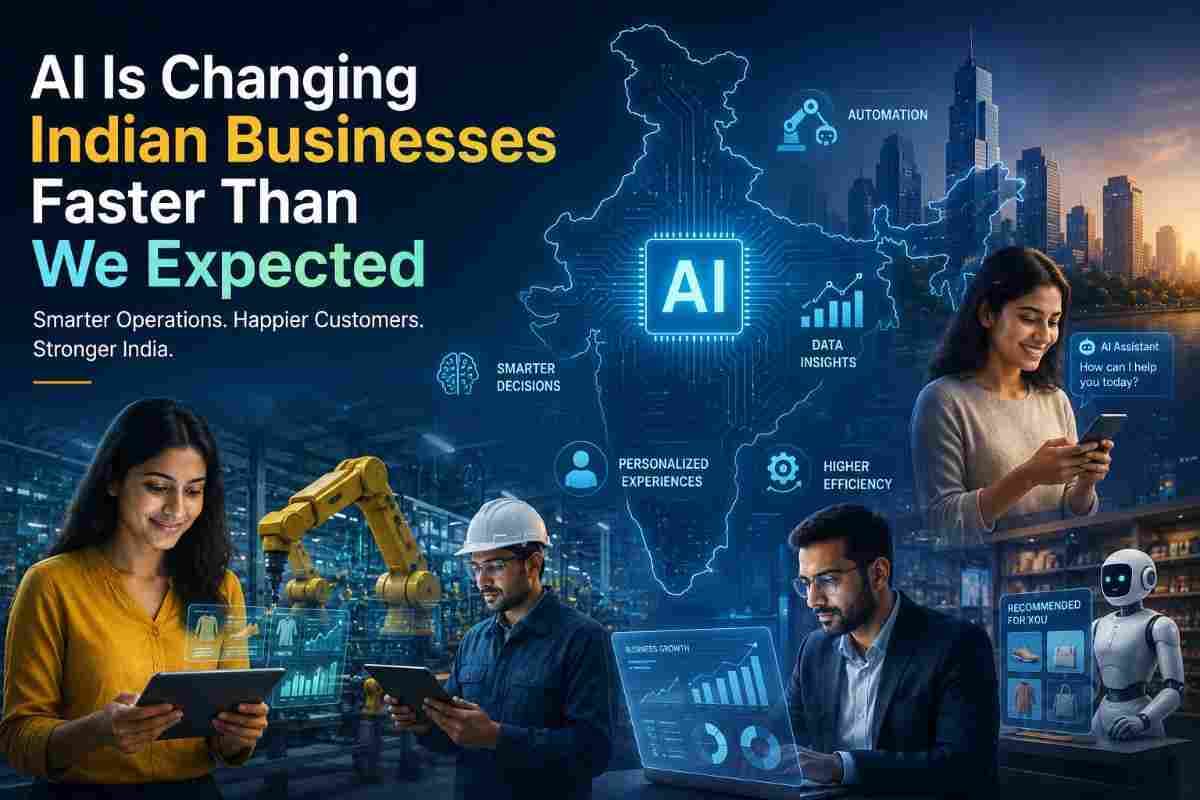
A couple of years ago, many businesses were still asking the same question: “What can we actually do with AI?”
That question is changing.
In 2026, Indian companies are increasingly asking where AI can save time, improve decisions, reduce repetitive work and help them serve customers better.
Deloitte’s 2026 India research found that Indian enterprises are moving beyond experimentation, with significant or full AI usage reported by 40% of respondents. Adoption is particularly strong in areas such as product development, strategy and operations, marketing and sales, and supply chain.
The interesting part is that AI is no longer limited to technology companies.
AI is becoming a business tool
For a small business, AI might mean writing product descriptions, answering routine customer questions or analysing sales data.
For a large company, the use case can be much broader: forecasting demand, automating internal workflows, helping developers write and test code, analysing documents or assisting sales teams.
The technology is changing quickly, but the business logic is simple.
If a task is repetitive, data-heavy or time-consuming, companies are asking whether AI can help.
Why Indian companies are moving quickly
India has a large services economy, a huge digital consumer base and businesses operating across multiple languages and markets.
That creates many areas where automation can have a practical impact.
Customer support is one example. Instead of sending every question to a human agent, businesses can use AI for first-level responses and send complicated cases to employees.
Marketing is another. AI can help teams create variations of campaigns, analyse customer behaviour and identify which messages are working.
In software development, AI assistants can speed up routine coding and testing work.
The goal is not always to replace people. Often, it is to let people spend less time on repetitive tasks.
The rise of AI agents
The next phase could be even more important.
Traditional generative AI responds to a prompt. AI agents are designed to take a sequence of actions toward a goal.
Imagine a sales agent that checks a lead, updates a CRM, prepares a proposal and schedules a follow-up.
Or a finance workflow that gathers documents, checks them against rules and sends exceptions to a human reviewer.
That is a very different business model from simply using a chatbot.
But it also creates a bigger responsibility.
Companies need permissions, monitoring, audit trails and human checkpoints before they allow AI systems to take important actions.
AI is creating new business opportunities
The AI wave is also creating opportunities for startups.
Enterprise voice systems, vertical AI software, AI-powered customer service, healthcare tools and industry-specific automation are attracting attention from investors.
Recent funding activity in India shows that investors are still backing AI businesses, but the market is becoming more practical. The strongest startups are increasingly expected to show a real product, real customers and a credible path to revenue.
That is a healthy shift.
The biggest mistake businesses can make
The biggest mistake is adopting AI simply because everyone else is doing it.
A company can spend money on AI tools and still gain very little if the underlying process is badly designed.
A better approach is to start with the problem.
Where are employees losing hours every week?
Where are customers waiting too long?
Where are errors happening?
Where is valuable data sitting unused?
Those questions often reveal better AI projects than simply buying the latest tool.
What happens to jobs?
This is one of the most discussed questions around AI.
The honest answer is that some tasks will become automated, while new tasks and roles will emerge.
Employees who learn to work with AI may become more productive. At the same time, companies may redesign jobs around judgment, communication, creativity and oversight.
The bigger change may be in the definition of a job itself.
Instead of asking whether AI will replace a person, businesses may increasingly ask which parts of a person's workflow can be handled by AI.
The next phase will be about results
The first AI phase was about experimentation.
The next phase is about return on investment.
Companies will want to know whether AI reduced costs, increased revenue, improved customer retention or helped employees work faster.
That shift will separate useful AI projects from expensive experiments.
The bottom line
AI is becoming part of the operating system of Indian businesses.
The winners may not necessarily be the companies with the biggest AI budgets. They may be the ones that identify practical problems, implement AI carefully and measure the result.
For business owners, the question is no longer simply “Should we use AI?”
It is:
“Which part of our business should become better because of AI?”
That is where the real opportunity begins.
Disclaimer: This article is for informational and educational purposes only.
The practical AI shift is happening inside departments
One reason AI adoption feels faster now is that businesses are no longer waiting for a company-wide transformation before starting.
A marketing team can introduce AI without changing the finance department. A software team can use coding assistants without asking every employee to become an AI expert. A customer-support team can automate routine questions while keeping human agents for complicated cases.
This department-by-department approach makes adoption easier.
It also creates a new management challenge: different teams can end up using different tools, storing information in different places and following different rules. Companies therefore need basic governance even when individual projects start small.
Data quality will decide how useful AI becomes
AI gets most of the attention, but data is often the less glamorous part of the story.
If a retailer's product catalogue contains outdated prices, an AI system can produce polished but incorrect answers. If a company has inconsistent customer records, automation can multiply the problem instead of solving it.
That is why businesses should clean important data before automating important workflows.
The most successful AI programmes may therefore involve a surprising amount of ordinary work: fixing databases, defining permissions, standardising processes and deciding who is responsible for errors.
AI can change the economics of smaller teams
A five-person team that can do the work previously requiring ten people has a very different cost structure.
That does not mean the company should immediately cut its workforce in half. It may instead use the extra capacity to serve more customers, launch more products or respond faster.
This distinction matters because productivity is not the same thing as job elimination.
If AI reduces the time needed for routine work, the business has a choice about what to do with the recovered time.
The best companies will probably reinvest part of it into higher-value work.
The skills gap is becoming a business issue
AI tools are easy to access, but using them well is not always easy.
Employees need to understand how to check outputs, protect sensitive information, structure tasks and recognise when an AI answer is unreliable.
That creates demand for practical AI literacy across organisations.
The future workforce may not need everyone to become a machine-learning engineer. It may need more people who understand how to combine domain expertise with AI tools.
A finance employee who understands both accounting and AI-assisted analysis can be more valuable than someone who knows only one side.
What businesses should watch next
The next stage of India's AI story will probably be measured less by the number of pilot projects and more by measurable outcomes.
Companies will ask whether customer response times fell, whether developers shipped faster, whether sales conversion improved or whether operating costs came down.
That is where the hype will meet reality.
The businesses that keep experimenting but measure results carefully are likely to learn faster than those that either adopt everything blindly or avoid AI completely.
A practical way to think about AI business India 2026
The easiest mistake when reading business news is to look for a single number that explains everything.
Markets and businesses rarely work that way.
A headline can tell you that activity is rising, but it does not tell you whether every company in the sector will benefit. A funding announcement can show that investors are interested, but it does not prove that the business will become profitable. A new technology can create a major opportunity, but implementation can still fail.
The useful habit is to connect the headline to the underlying business model.
Who is paying?
Why are they paying?
What does it cost to serve them?
What could make the economics better or worse?
What changes if the market becomes more competitive?
Those questions are useful whether you are an investor, entrepreneur or simply someone trying to understand India's economy.
The other important habit is to separate a trend from a guarantee.
A trend tells us where activity is moving. It does not tell us exactly where the next winner will come from.
That distinction is particularly important in fast-moving areas such as technology, IPOs, startups and financial services. New companies can grow quickly, but competition can also appear quickly. Regulations can change. Consumer preferences can shift. Capital can become more expensive.
For readers, this means the most valuable business stories are not necessarily the ones with the most dramatic headlines.
They are the stories that explain what changed, why it changed and what could happen next.
That is the lens through which this trend should be viewed.
What readers should watch next
Over the coming months, pay attention to the practical signals behind the trend.
Look for companies reporting real revenue growth rather than only announcing plans. Watch whether customers continue using a product after the initial launch. Look at whether businesses can improve margins as they scale. Notice whether investment is creating new capacity, new jobs or new products.
Also watch what happens when the market becomes less supportive.
A strong business should have a strategy for difficult periods, not only good ones.
That is often where the difference between a genuine long-term trend and a short-lived boom becomes visible.
For India, the broader opportunity remains significant. A large domestic market, a growing digital economy, improving infrastructure and an increasingly connected business ecosystem create room for new companies and new business models.
But opportunity alone is not enough.
Execution will decide who benefits.
Disclaimer: This article is for informational purposes only and is not investment, financial or business advice.