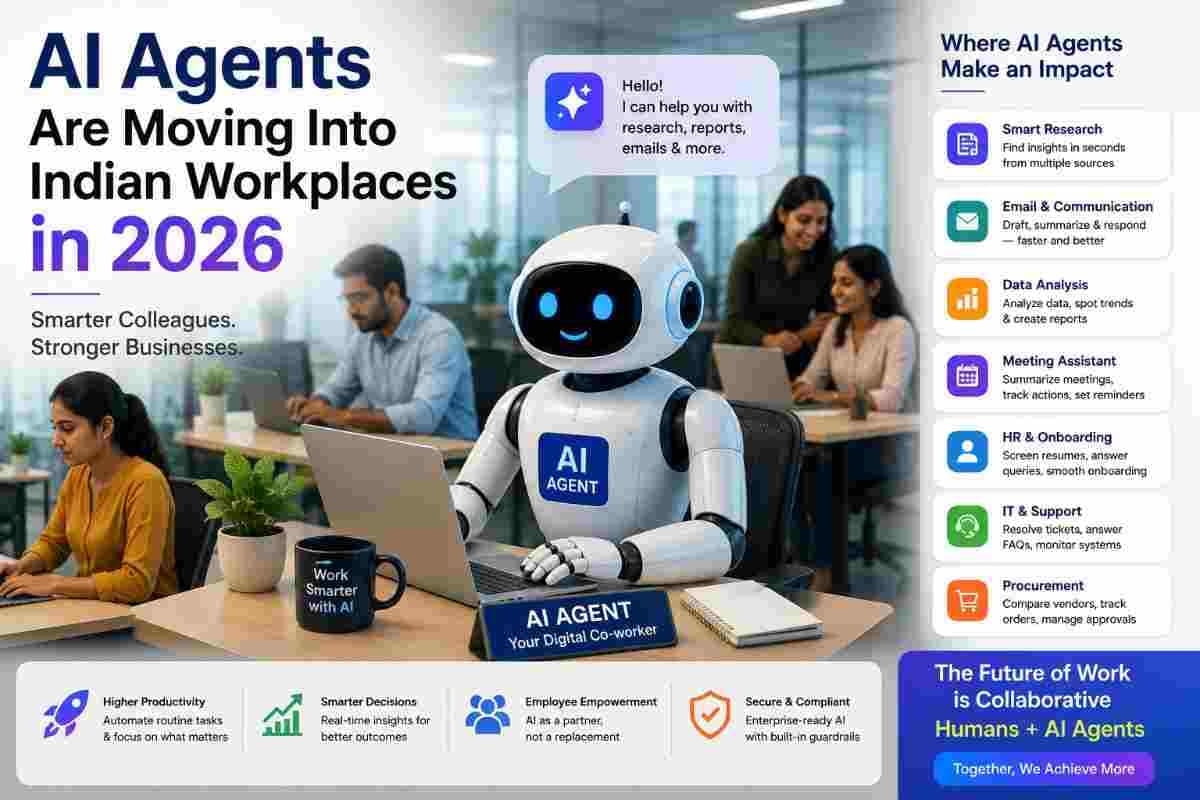
The first wave of business AI was mostly about asking questions.
Write an email.
Summarise a document.
Create a presentation.
Generate code.
The next wave is different.
AI agents are being designed to complete sequences of tasks, interact with software and work toward a defined business goal.
That could have a much bigger impact on Indian businesses than simple chatbots.
What is an AI agent?
A normal AI assistant waits for a prompt and gives you an answer.
An AI agent can be given a goal and allowed to take several steps.
For example, a sales agent might review a lead, check a CRM, identify the customer's history, prepare a follow-up message and schedule a meeting.
A finance agent might collect documents, check information against rules and flag exceptions for a human employee.
The important change is action.
Why businesses are interested
Indian companies have huge volumes of repetitive workflows.
Customer service, document processing, sales operations, finance, procurement and software development all involve tasks that follow patterns.
If an AI system can handle part of that workflow reliably, employees can spend more time on decisions that require judgment.
That is the business case.
It is not simply about having an impressive AI demo.
Agentic AI can also modernise old systems
Many large companies still operate with legacy software.
Replacing those systems can be expensive and risky.
Recent industry discussions around agentic AI have focused on using AI to understand old code, automate parts of migration and help with testing and remediation.
That does not mean an AI agent should be given unlimited access to production systems.
It means AI could become another layer that helps organisations modernise systems while keeping people involved in critical decisions.
The biggest challenge is trust
The more freedom an AI system has, the more important governance becomes.
A chatbot giving you a wrong answer is frustrating.
An AI agent sending the wrong payment, changing a customer record or exposing confidential information can become a serious business problem.
Companies therefore need permissions, monitoring, audit logs and human checkpoints.
They also need clear rules about what an agent can and cannot do.
Small businesses can benefit too
Agentic AI is not only for large corporations.
A small company could use an agent to organise leads, prepare quotations, monitor customer requests or create internal reports.
The benefit is particularly interesting for businesses that cannot afford large operations teams.
But small companies should start with narrow workflows.
Automate one process.
Measure the result.
Fix the problems.
Then expand.
AI agents will change the meaning of productivity
For years, productivity software has helped employees do tasks faster.
Agentic AI could go one step further by handling parts of the task itself.
That may change how companies measure work.
Instead of asking how many people are needed to process 10,000 requests, businesses may start asking how much of the process can be automated while maintaining quality.
This could improve efficiency, but it will also require employees to learn new skills.
The human role is not disappearing
Businesses still need people for judgment, accountability, relationships and decisions involving uncertainty.
The likely model is collaboration.
AI handles repetitive steps.
People handle exceptions and important decisions.
That model can work well if companies design the workflow carefully.
The bottom line
AI agents could become one of the most important business technology trends of 2026.
The opportunity is large, but the companies that benefit most will probably not be the ones that automate everything overnight.
They will be the ones that choose the right workflows, define clear permissions and keep humans involved where the stakes are high.
The future of business AI may not be “AI versus employees.”
It may be employees with AI agents versus businesses that have not adopted them.
Disclaimer: This article is for informational purposes and should not be treated as technology, financial or business advice.
Where AI agents could make the biggest difference
The first areas to benefit are likely to be workflows with clear rules and repeatable steps.
Customer support is one example.
Sales operations is another.
Finance, procurement, IT help desks, compliance checks and internal reporting also contain many structured processes.
In each case, an agent can potentially gather information, make a preliminary decision and either complete the task or send it to a human.
The key word is potentially.
Reliability has to be proven before the workflow is trusted.
Agents need boundaries
A business should not give an AI agent unlimited access just because the technology allows it.
Permissions should match the risk of the task.
An agent that drafts an email needs less authority than one that approves a payment.
An agent that summarises a customer record needs less authority than one that changes that record.
This sounds obvious, but as systems become more capable, permission design becomes a core part of AI deployment.
Human-in-the-loop systems will remain important
For high-impact decisions, the most practical model may be human-in-the-loop automation.
The AI does the routine work.
A person reviews exceptions.
That can still deliver significant productivity gains because humans no longer need to inspect every normal case.
Instead, they spend their time on unusual or sensitive cases.
The infrastructure challenge
Agentic AI also requires companies to connect systems that may have been built separately.
A CRM, ERP, help desk, document store and communication platform may all contain different pieces of information.
An agent becomes more useful when it can work across those systems safely.
That creates demand for better APIs, identity management, observability and data governance.
In other words, the AI agent trend may create business for a whole layer of supporting technology.
Indian IT companies have an interesting opportunity
Indian technology service providers already have experience integrating enterprise systems.
If they can combine that capability with modern AI agents, they could help global companies redesign workflows rather than simply build chatbots.
That may move Indian IT services further toward outcome-based technology work.
The challenge will be proving measurable value.
Clients will increasingly ask what an AI implementation changed, not simply whether an AI model was included.
The future is likely to be gradual
Businesses rarely transform overnight.
They test one workflow, learn from failures, improve controls and then expand.
That is probably the right path for agentic AI too.
The technology is powerful enough to create real efficiency gains, but the companies that use it responsibly will have an advantage over those that chase automation without understanding the risks.
A practical way to think about AI agents for business India
The easiest mistake when reading business news is to look for a single number that explains everything.
Markets and businesses rarely work that way.
A headline can tell you that activity is rising, but it does not tell you whether every company in the sector will benefit. A funding announcement can show that investors are interested, but it does not prove that the business will become profitable. A new technology can create a major opportunity, but implementation can still fail.
The useful habit is to connect the headline to the underlying business model.
Who is paying?
Why are they paying?
What does it cost to serve them?
What could make the economics better or worse?
What changes if the market becomes more competitive?
Those questions are useful whether you are an investor, entrepreneur or simply someone trying to understand India's economy.
The other important habit is to separate a trend from a guarantee.
A trend tells us where activity is moving. It does not tell us exactly where the next winner will come from.
That distinction is particularly important in fast-moving areas such as technology, IPOs, startups and financial services. New companies can grow quickly, but competition can also appear quickly. Regulations can change. Consumer preferences can shift. Capital can become more expensive.
For readers, this means the most valuable business stories are not necessarily the ones with the most dramatic headlines.
They are the stories that explain what changed, why it changed and what could happen next.
That is the lens through which this trend should be viewed.
What readers should watch next
Over the coming months, pay attention to the practical signals behind the trend.
Look for companies reporting real revenue growth rather than only announcing plans. Watch whether customers continue using a product after the initial launch. Look at whether businesses can improve margins as they scale. Notice whether investment is creating new capacity, new jobs or new products.
Also watch what happens when the market becomes less supportive.
A strong business should have a strategy for difficult periods, not only good ones.
That is often where the difference between a genuine long-term trend and a short-lived boom becomes visible.
For India, the broader opportunity remains significant. A large domestic market, a growing digital economy, improving infrastructure and an increasingly connected business ecosystem create room for new companies and new business models.
But opportunity alone is not enough.
Execution will decide who benefits.
The first winners may be the companies with better processes
AI cannot fix a workflow that is already chaotic.
If five employees store customer information in five different formats, an agent will have difficulty producing reliable results. If approval rules are unclear, automation may simply move the confusion from people to software.
That is why process design is becoming an important part of the AI-agent conversation.
Before deploying an agent, businesses should map the workflow, identify the information it needs, define the decisions it is allowed to make and create a clear escalation path.
This can sound like extra work, but it is exactly what makes automation safer.
The companies that get these basics right may be able to automate more confidently than companies that start with technology and think about the process later.
For India's large services sector, this could become a significant opportunity. AI agents may not replace the need for skilled teams, but they can change what those teams spend their time doing. Routine coordination can move to software while employees focus on client relationships, complex decisions and specialised knowledge.
That is a more realistic way to think about the workplace impact of agentic AI.
Disclaimer: This article is for informational purposes only and is not investment, financial or business advice.