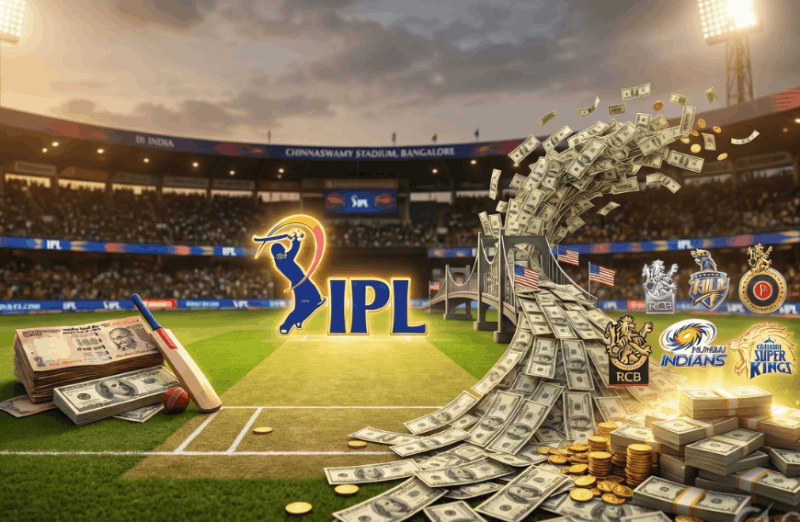
The Indian Premier League is as much a business story as a sporting one. Franchises are privately owned companies with revenue lines, cost structures and margins — and the way that money flows is quite different from what most fans assume.
Where the revenue comes from
A franchise's income broadly falls into four buckets:
- Central revenue share. The league sells its media and broadcast rights centrally, then distributes a share of that pool to every franchise. For most teams this is comfortably the largest single line item, and it arrives regardless of where the team finishes on the table.
- Sponsorships. Jersey sponsors, kit partners and team-level brand deals are negotiated by each franchise individually, so strong brands and consistent on-field performance genuinely move this number.
- Gate receipts. Ticket revenue from home matches. It's the most visible income stream to fans, but it is a comparatively small share of the total for most franchises.
- Merchandise and licensing. Growing, but still modest relative to broadcast money in the Indian market.
Where the money goes
On the cost side, the dominant item is the player salary purse. The BCCI sets a cap each season on what a franchise may spend assembling its squad, which is why auction strategy matters so much: every team is working within the same budget ceiling, so value per rupee spent becomes the real competitive lever.
Beyond salaries, franchises carry support staff and coaching costs, travel and accommodation, training facilities, and marketing spend. Some teams also pay an annual franchise fee depending on the terms under which they entered the league.
Why the central pool changes the incentives
Because a large share of revenue is distributed centrally and does not depend on finishing position, the downside of a bad season is cushioned in a way it is not in many other sports leagues. This is deliberate — it keeps every franchise financially viable, which in turn keeps the league competitive.
It also explains why franchise valuations have held up even for teams that have gone through weak seasons: the buyer is purchasing a share of a growing central media pool, not just a trophy cabinet.
What to watch
If you follow the business side of sport, the numbers that matter most are the media rights cycle (renegotiated periodically, and the single biggest driver of franchise economics), the salary cap trajectory, and how much non-central revenue the strongest brands can generate on their own.
The takeaway
A cricket franchise is best understood as a media business with a team attached. On-field performance matters for sponsorship and fan engagement, but the shape of the broadcast deal is what sets the financial baseline for the entire league.