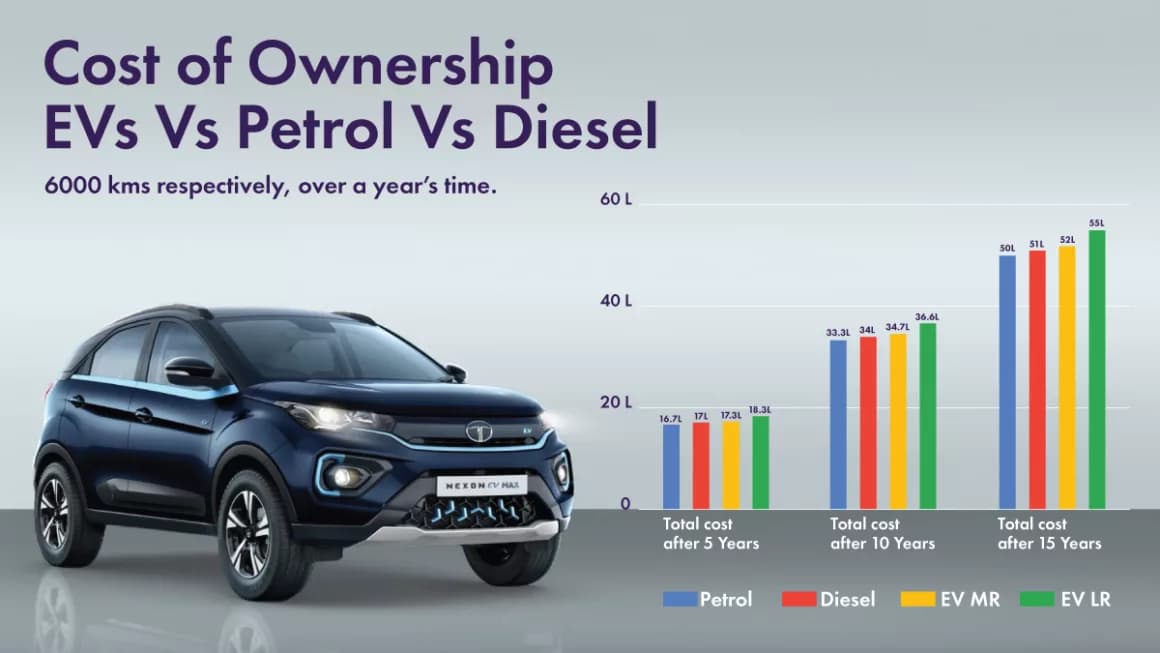
Electric vehicles usually cost more to buy and less to run than a comparable petrol car. Whether that trade works out in your favour depends almost entirely on how much you drive — which is why comparing showroom prices alone will mislead you.
Here's how to run the comparison properly.
Step 1: Start with the on-road price, not the ex-showroom price
The number quoted in advertising is typically ex-showroom. What you actually pay includes registration, road tax and insurance. EVs often attract lower road tax and registration charges depending on your state, so the gap between an EV and a petrol car narrows once you move from ex-showroom to on-road pricing. Get both figures for both cars before comparing anything else.
Step 2: Work out your running cost per kilometre
This is where EVs make up ground.
For a petrol car, divide the current fuel price by the car's realistic mileage. A car returning 15 km per litre with petrol at ₹100 per litre costs roughly ₹6.7 per kilometre in fuel.
For an EV, take the battery's usable capacity in kWh, multiply by your electricity tariff, and divide by the realistic range. A 40 kWh battery charged at ₹8 per unit costs ₹320 for a full charge; if that delivers 300 km of real-world range, you're at roughly ₹1.1 per kilometre.
Two things to be honest about here: use realistic mileage and range, not the certified figures, and use your actual home electricity tariff. If you depend on public fast charging, your per-unit cost will be significantly higher and the advantage shrinks.
Step 3: Add maintenance
EVs have far fewer moving parts — no engine oil changes, no clutch, no exhaust system, and regenerative braking reduces brake pad wear. Annual servicing is generally cheaper. Petrol cars have a more predictable and widely available service network, which matters more in smaller towns.
Step 4: Find your break-even distance
Now put it together:
- Take the on-road price difference between the two cars.
- Take the running cost difference per kilometre.
- Divide the first by the second.
That gives you the number of kilometres you need to drive before the EV's lower running costs repay its higher purchase price. Compare that against how much you realistically drive in a year. Someone covering 20,000 km a year reaches break-even far sooner than someone covering 5,000 km.
Step 5: Consider the factors that aren't in the spreadsheet
- Battery warranty and replacement. Check the warranty term and what it covers. Battery replacement outside warranty is a significant cost.
- Charging access. A home charging point changes EV economics completely. Without dependable home or workplace charging, running costs and convenience both suffer.
- Resale value. EV resale in India is still maturing, so there's more uncertainty here than with an established petrol model.
- Usage pattern. Frequent long highway drives need charging infrastructure planning in a way city commuting does not.
The takeaway
There is no universal answer — the honest one is "it depends on your annual mileage and your charging situation." Run the break-even calculation with your own numbers rather than relying on a general claim that one option is cheaper. High-mileage drivers with home charging usually come out ahead with an EV; low-mileage drivers without it often don't.