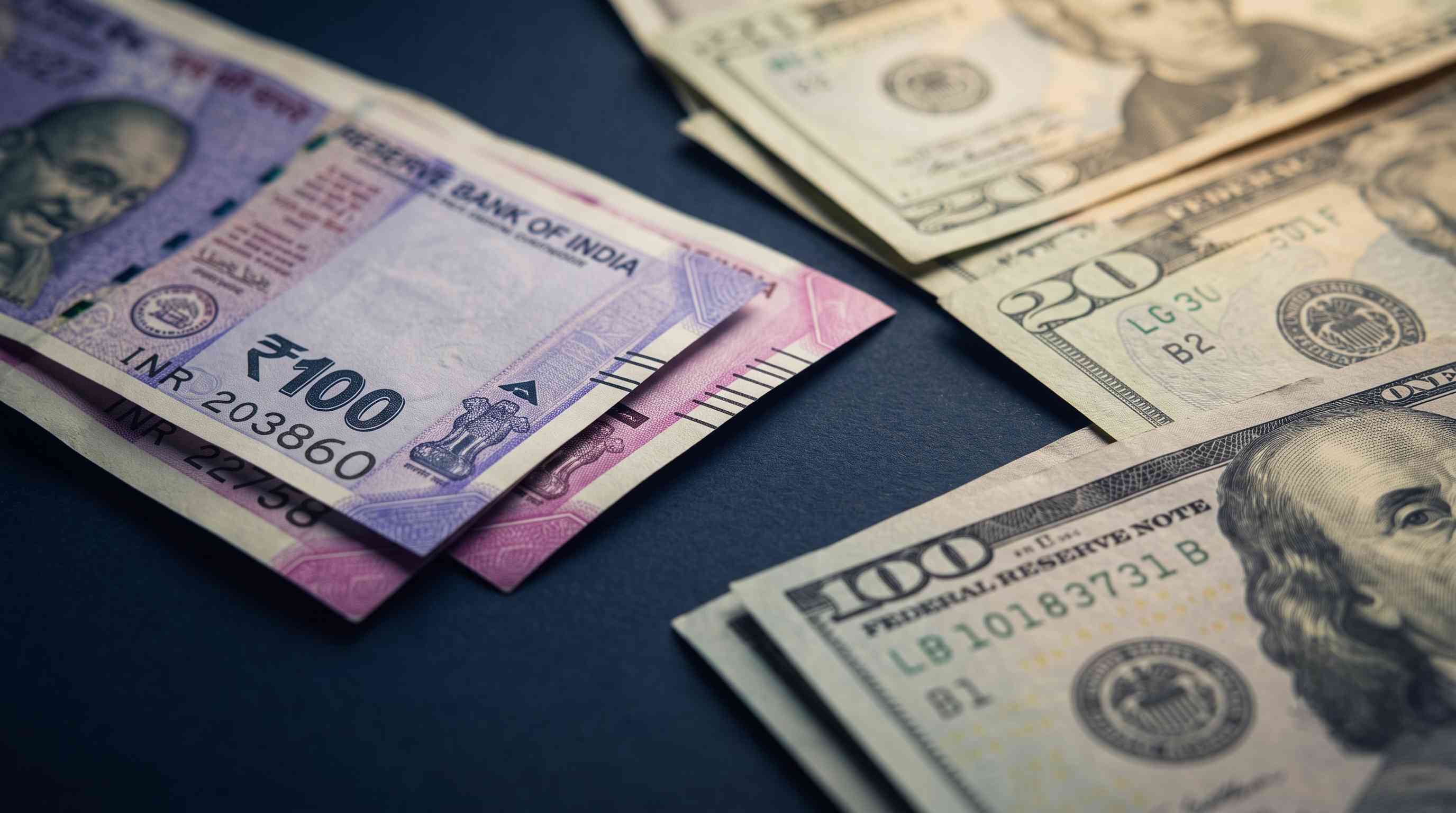
The rupee-dollar exchange rate is one of those numbers that appears so often in financial news that it can start to feel like background noise.
For traders and large companies, it is obviously important. But the exchange rate is not confined to dealing rooms or business headlines. It can quietly influence the cost of things people buy, the amount they spend overseas and the way businesses plan their money.
Think about a family preparing for a holiday abroad. Or a student getting ready to pay for education outside India. An investor putting money into an international fund also has to deal with the currency conversion. For an importer, the exchange rate can affect the cost of goods or raw materials. For an exporter, it can change the rupee value of money earned overseas.
That is why a steady rupee can matter even when you have no intention of trading currencies.
A stable exchange rate does not mean the rupee stays at exactly the same level every day. Currencies move. What matters is whether those moves are orderly enough for households, investors and businesses to plan without constantly having to guess what their costs or revenues will look like.
What actually moves the rupee?
There is no single switch that decides whether the rupee rises or falls against the US dollar.
The currency responds to several forces at the same time. Some come from India's own economy, while others are connected to global markets.
The most important factors include crude oil prices, foreign investment flows, activity by the Reserve Bank of India and changes in US interest rates.
These factors do not always point in the same direction. That is one reason currency movements can sometimes look confusing from the outside.
Crude oil can put pressure on the rupee
India imports most of the oil it uses, which makes crude prices an important part of the currency story.
Oil is traded internationally in dollars. So when crude prices rise, Indian buyers need more dollars to pay for their imports. That increases demand for the US currency and can put pressure on the rupee.
The effect can extend beyond the price of oil itself.
Higher fuel costs can feed into transportation and other business expenses. Companies that move goods from one place to another have to account for those costs. Businesses using imported inputs can also find their budgets changing.
This does not mean every increase in crude oil prices will automatically produce the same movement in the rupee. Other forces are active at the same time.
Still, oil matters because it creates a direct connection between India's import bill and the demand for dollars.
For anyone trying to understand why the rupee is moving, crude oil is therefore one of the first things worth watching.
Foreign investment can change the currency equation
Money moving into and out of Indian financial markets is another important part of the picture.
When foreign investors buy Indian equities or bonds, they bring dollars into the country. Those dollars are converted into rupees for the investment. Sustained foreign buying can therefore provide support to the Indian currency.
The reverse can happen when foreign investors sell Indian assets and move money back into dollar-denominated investments.
It sounds straightforward, but the real market is more complicated.
Investors do not make decisions based on the rupee alone. They look at returns, interest rates, company performance, economic conditions and the broader mood in global markets.
That means foreign investment flows can change quickly when expectations change.
A period of strong buying may provide support to the rupee. A period of heavy selling can create pressure. Neither situation tells the entire story on its own, but both can help explain why the exchange rate is moving.
For domestic investors, this is useful context. It shows that the rupee is affected not only by what is happening inside India, but also by how global investors view Indian assets.
US interest rates matter from far beyond America
The US dollar has a central role in international finance, so changes in US interest rates can affect markets well outside the United States.
When US interest rates are higher, dollar-denominated assets can become more attractive to investors. If more capital moves toward those assets, demand for dollars can increase.
That can put pressure on emerging-market currencies, including the rupee.
The important part is that markets do not always wait for an actual rate change.
Expectations matter too.
If investors begin to believe that US interest rates will stay high for longer, financial markets can respond to that expectation. If expectations change in the other direction, the currency market can react again.
This is one reason the rupee can move on economic data, inflation figures or comments from central-bank officials even when there has been no immediate change in India's own policy.
For ordinary readers, the lesson is fairly simple: the rupee is connected to global financial conditions.
What role does the RBI play?
The Reserve Bank of India also has an important role in the foreign-exchange market.
The RBI does not simply announce one exchange-rate number and promise to keep the rupee there. Instead, it can use the foreign-exchange market to help smooth excessive volatility and support orderly market conditions.
That distinction is important.
A currency is expected to move as economic conditions change. The objective is not necessarily to stop every rise or fall. The concern is more about avoiding disorderly movements that can make financial planning unnecessarily difficult.
Consider an Indian business that has to pay a foreign supplier. If the rupee moves sharply between the time the company agrees to the purchase and the time the payment is made, the rupee cost can change even though the dollar price has not.
An exporter faces the other side of the problem. The company may receive dollars from overseas customers, but its business expenses may be in rupees. The value of those dollar earnings changes when converted.
A more orderly currency market makes these calculations easier.
That is one reason the RBI's presence in the foreign-exchange market matters to businesses even when they never interact with the central bank directly.
Why does a stable rupee matter?
For businesses, predictability is often more useful than a particular exchange-rate number.
An importer needs to know what products, machinery or raw materials are likely to cost. An exporter needs to estimate how much foreign-currency revenue will be worth after conversion into rupees.
Sharp swings can make both calculations harder.
Suppose an importer has planned its budget around a particular dollar price. If the rupee weakens before the payment is made, the final rupee cost can be higher.
Now look at an exporter.
A weaker rupee can mean that dollar earnings convert into more rupees. That may sound like an obvious advantage. But the picture changes if the same exporter also relies on imported machinery, components or raw materials.
Higher import costs can reduce some of the benefit.
This is why it is difficult to label a weaker rupee as simply good or bad for the economy.
Different businesses have different exposures.
The same currency movement can help one company while creating a challenge for another.
What happens when the rupee weakens?
A weaker rupee means that more rupees are needed to buy a US dollar.
The most direct effect is on imports and expenses priced in foreign currency.
Fuel is an important example because India imports most of its oil and international oil transactions are largely conducted in dollars. Imported goods and raw materials can also become more expensive in rupee terms.
For households, the effect may become visible when they have to make payments abroad.
A student paying foreign education expenses needs more rupees if the same dollar payment becomes more expensive. A family travelling overseas faces a similar issue because many of its expenses are ultimately priced in foreign currencies.
International investments can be affected as well.
If an investment is held in a foreign market, its value for an Indian investor is influenced not only by the performance of the investment itself, but also by the exchange rate used to convert that value back into rupees.
That does not mean currency movements should automatically be treated as a reason to buy or sell an investment.
It simply means that currency is another part of the calculation.
What happens when the rupee strengthens?
A stronger rupee can provide the opposite effect.
Imported goods and foreign expenses can become relatively cheaper in rupee terms. That can be useful for importers, travellers and people making payments abroad.
But exporters may face a different situation.
When foreign earnings are converted back into rupees, a stronger rupee can reduce the amount received in domestic currency compared with a weaker exchange rate.
Again, the outcome depends on the business.
A company that earns money overseas but also has significant foreign-currency expenses may have a different experience from a company whose revenues come mainly from exports while most of its costs are domestic.
There is no single winner from every currency move.
That is why the broader economic picture matters more than a headline saying that the rupee has strengthened or weakened.
How can the rupee affect inflation?
The exchange rate can influence inflation through imported goods and inputs.
When the rupee weakens, businesses paying for imports may face higher costs in rupee terms. Some companies may absorb those additional costs. Others may eventually pass part of them on to customers.
The effect does not necessarily appear immediately.
A business may already have inventory purchased earlier. It may have agreements that lock in prices for a period. It may also have ways of managing its currency exposure.
Because of these differences, the exchange rate should be seen as one part of the inflation picture rather than the only explanation for changes in prices.
Crude oil is particularly important here because changes in both oil prices and the rupee can influence the cost of imported energy.
For households, that connection is worth understanding even if they never look at a currency chart.
What does all this mean for your money?
The practical impact depends largely on whether you have a direct connection to foreign currency.
If your income, spending and investments are mostly within India, a small daily change in the rupee-dollar rate may not make much difference to your personal finances.
But the situation changes when you have a dollar-based expense.
Someone planning an overseas trip may care about the exchange rate because it affects the rupee cost of the trip.
A student preparing to pay foreign education fees has an even more direct exposure because the payment may be large and fixed in a foreign currency.
An investor holding international funds also needs to understand that currency movements can influence the value of those investments when measured in rupees.
For these people, watching the broader trend can be more useful than reacting to every day's movement.
Should you worry about every daily move?
Probably not.
Currency markets can change every day, sometimes for reasons that have little practical relevance to an individual's financial plans.
A small movement may not matter much if your financial life is largely in rupees. Spending too much time reacting to every headline can make a long-term financial decision feel like a short-term trading decision.
The more useful question is whether you have a meaningful foreign-currency exposure.
If you do, planning becomes more important.
For example, someone with a large overseas payment coming up may want to understand how currency movements could affect the total rupee cost. An investor with international exposure may want to understand the currency component of the investment rather than looking only at the underlying asset.
For everyone else, the rupee-dollar exchange rate is often better used as an economic indicator.
Why businesses watch the exchange rate so closely
Currency risk can affect both sides of a company's finances.
An importer may agree to purchase goods at a dollar price today but make the actual payment later. If the rupee changes during that period, the final cost in rupees can be different from the original estimate.
An exporter has a related but opposite concern.
The company may earn dollars from overseas customers, but its employees, offices and many other expenses may be paid in rupees. The amount of domestic revenue generated from those foreign earnings therefore depends partly on the exchange rate.
Businesses can use hedging strategies to manage some currency risk. Others naturally balance foreign-currency income with foreign-currency expenses.
The details vary from company to company.
The bigger point is that the exchange rate becomes part of business planning. It affects budgets, pricing decisions and expectations about margins.
A relatively orderly currency market can make those decisions easier.
What should an ordinary investor watch?
You do not need to become a currency trader to understand what is happening to the rupee.
A few broad indicators can provide useful context.
Crude oil prices: Higher oil prices can increase India's need for dollars because the country imports most of its oil.
Foreign investment flows: Sustained buying or selling by foreign investors can influence demand for rupees and dollars.
US interest rates: Changes in US rates, and even changes in expectations about future rates, can affect the attractiveness of dollar-denominated assets.
RBI activity: The central bank can use the foreign-exchange market to help manage excessive volatility and maintain orderly conditions.
Import and export conditions: The flow of goods and payments across borders is closely connected with the demand and supply of foreign currency.
These indicators will not tell you exactly where the rupee will move next.
They can, however, make the headlines easier to understand.
The bigger picture
It is tempting to look at the rupee-dollar exchange rate as a simple contest between two currencies: the rupee goes up, or the dollar goes up.
The reality is more connected than that.
Oil prices affect India's import requirements. Foreign investors move capital between markets. US interest rates influence the appeal of dollar assets. Businesses deal with foreign-currency costs and revenues. The RBI watches market conditions and can act to reduce excessive volatility.
All of those forces meet in the currency market.
That is why a steady rupee can be useful news even when the number itself does not change much.
For a business, stability can make it easier to prepare a budget.
For a student, it can make an overseas payment easier to estimate.
For a traveller, it can make a foreign trip easier to plan.
For an investor, it can provide a clearer picture of how international exposure may affect returns in rupee terms.
None of this means the rupee should remain fixed.
Currencies naturally move as economic and financial conditions change. What matters for households and businesses is having enough predictability to make sensible decisions.
The bottom line
The rupee-dollar exchange rate may look like a number meant for financial news channels, but its effects are much closer to everyday life than they first appear.
Crude oil prices can influence dollar demand. Foreign investment flows can support or pressure the rupee. US interest rates can change global demand for dollar assets. RBI activity can help keep market conditions orderly.
A weaker rupee can raise the rupee cost of imports and foreign expenses, while potentially helping some exporters. A stronger rupee can benefit importers and people paying overseas expenses, while creating pressure for some export businesses.
For most people, there is no need to react to every daily currency headline.
Instead, start with your own exposure.
If you are travelling, studying abroad or investing internationally, the exchange rate can have a direct effect on your finances. If most of your financial life is in India, the rupee-dollar rate is still useful, but mainly as a way to understand broader issues such as import costs, inflation and business conditions.
The important thing is not simply whether the rupee is stronger or weaker on a particular day.
It is understanding why it is moving, how those changes can affect you, and whether you actually have a financial reason to act.
Disclaimer: This article is for informational purposes only and is not investment or financial advice. Currency markets can change quickly, and readers should consider their own circumstances before making financial decisions.