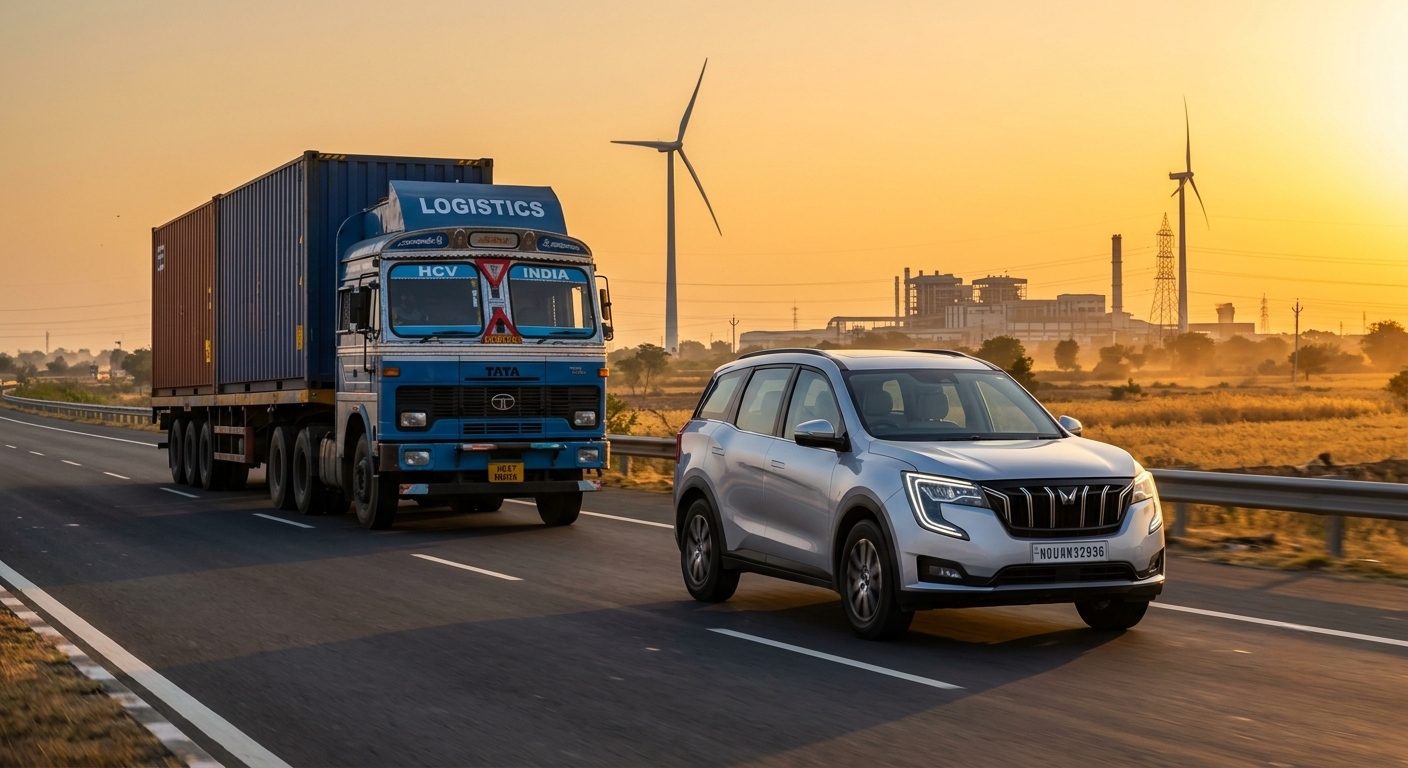
In a stock market environment where many industrial sectors are struggling with unpredictable commodity prices and shifting global demand, the Indian automotive sector stands out as a clear outperformer.
Leading this sector rally is Mahindra & Mahindra (M&M), alongside prominent manufacturers in the Heavy Commercial Vehicle (HCV) space.
Why is the automotive industry attracting heavy institutional capital while other cyclical sectors experience profit-booking?
This extensive case study breaks down the specific growth drivers, structural industry shifts, and operational mechanics powering India’s auto stock boom.
1. The Macro Backdrop: Three Growth Engines Firing Simultaneously
Unlike previous automotive cycles that depended on a single segment (such as urban passenger cars), the current rally is driven by three distinct economic engines operating at the same time:
Engine A: The Shift Toward Premium SUVs
Indian consumer buying preferences have undergone a permanent transformation over the past five years. Entry-level hatchback sales have plateaued, while demand for Sport Utility Vehicles (SUVs) has skyrocketed. Consumers are increasingly opting for higher-end vehicle trims equipped with advanced electronics, panoramic sunroofs, and connected technology.
This shift toward premium models has significantly increased Average Selling Prices (ASPs) and gross operating margins for manufacturers equipped with strong SUV portfolios.
Engine B: Commercial Infrastructure Push
National infrastructure spending on highways, freight corridors, port expansion, and mining projects requires heavy-duty machinery. Heavy commercial vehicles—such as multi-axle tipper trucks, long-haul freight carriers, and construction vehicles—are seeing sustained replacement demand from logistics operators modernizing their fleets.
Engine C: Rural Income Revival
A well-distributed monsoon across key agricultural belts directly influences rural purchasing power. Higher crop yields boost farm incomes, driving tractor sales, light commercial vehicle (LCV) utility purchases, and entry-level two-wheeler demand across tier-2 and tier-3 towns.
2. Corporate Case Study: Mahindra & Mahindra's Strategic Turnaround
To understand why M&M's stock price has consistently hit fresh highs, one must examine the corporate strategy the company executed over recent years.
Laser Focus on Core Competencies
A few years ago, M&M’s management took a conscious capital allocation decision: exit unprofitable foreign ventures and double down on core domestic strengths—namely SUVs and Farm Equipment.
+-------------------------------------------------------------------+
|               M&M'S STRATEGIC GROWTH FLYWHEEL                     |
|                                                                   |
|   Exit Unprofitable Foreign Assets --> Focus Capital on SUVs/Farm |
|                 ^                                    |            |
|                 |                                    v            |
|   Reinvest Cash Flows into Tech <--- Generate High Operating Cash |
+-------------------------------------------------------------------+
Building Massive Product Order Backlogs
By launching feature-packed, competitively priced SUV models, M&M built massive customer waiting lists. Maintaining order backlogs gives the company exceptional revenue visibility over upcoming quarters, protecting its financial performance against temporary market slowdowns.
Dominance in Farm Equipment
M&M commands roughly 40% of the Indian tractor market. As rural cash flows strengthen, tractor sales provide high-margin cash flows that the company can reinvest into developing next-generation Electric Vehicles (EVs) and advanced automotive platforms.
3. The Heavy Commercial Vehicle (HCV) Upswing
The commercial vehicle segment operates under distinct economic rules compared to passenger cars. When logistics operators buy commercial trucks, it is a pure business investment based on return on capital.
Current drivers in the HCV space include:
- Fleet Modernization for Fuel Efficiency: Rising diesel costs force logistics firms to replace older, inefficient trucks with modern BS-VI compliant models that offer superior mileage and lower maintenance costs.
- Rapid Expansion of E-Commerce Logistics: The rapid growth of quick-commerce and nationwide retail delivery networks requires robust hub-and-spoke transport infrastructure, keeping demand for medium and heavy freight trucks high.
- Alternative Fuel Adoption: Commercial vehicle makers are successfully launching Liquefied Natural Gas (LNG) and electric commercial fleets, attracting ESG-focused corporate logistics clients.
4. Margin Expansion: Easing Input Costs
Beyond strong top-line sales volumes, auto manufacturers are benefiting from improved profitability margins.
During 2021 and 2022, automotive profitability was severely squeezed by soaring prices for key raw materials—including steel, aluminum, copper, and precious metals used in catalytic converters.
Over the past year, raw material costs have stabilized. Because automakers successfully raised retail vehicle prices during high-inflation periods, stabilizing commodity costs now translates directly into expanding gross margins.
5. Investment Outlook and Risks to Watch
While the fundamentals for M&M and commercial vehicle makers remain compelling, smart investors should track potential sector risks:
- Interest Rate Sensitivity: The majority of passenger and commercial vehicles in India are purchased using vehicle loans. Prolonged high interest rates could eventually make monthly auto EMIs less affordable for budget-conscious buyers.
- Monsoon Distribution Spikes: Uneven monsoon distribution or localized flooding can temporarily disrupt rural tractor sales in specific geographic pockets.
Conclusion: For long-term portfolios, the automotive sector—particularly companies with strong market positioning in commercial transport and premium SUVs—remains one of the most reliable growth plays on India's expanding domestic economy.